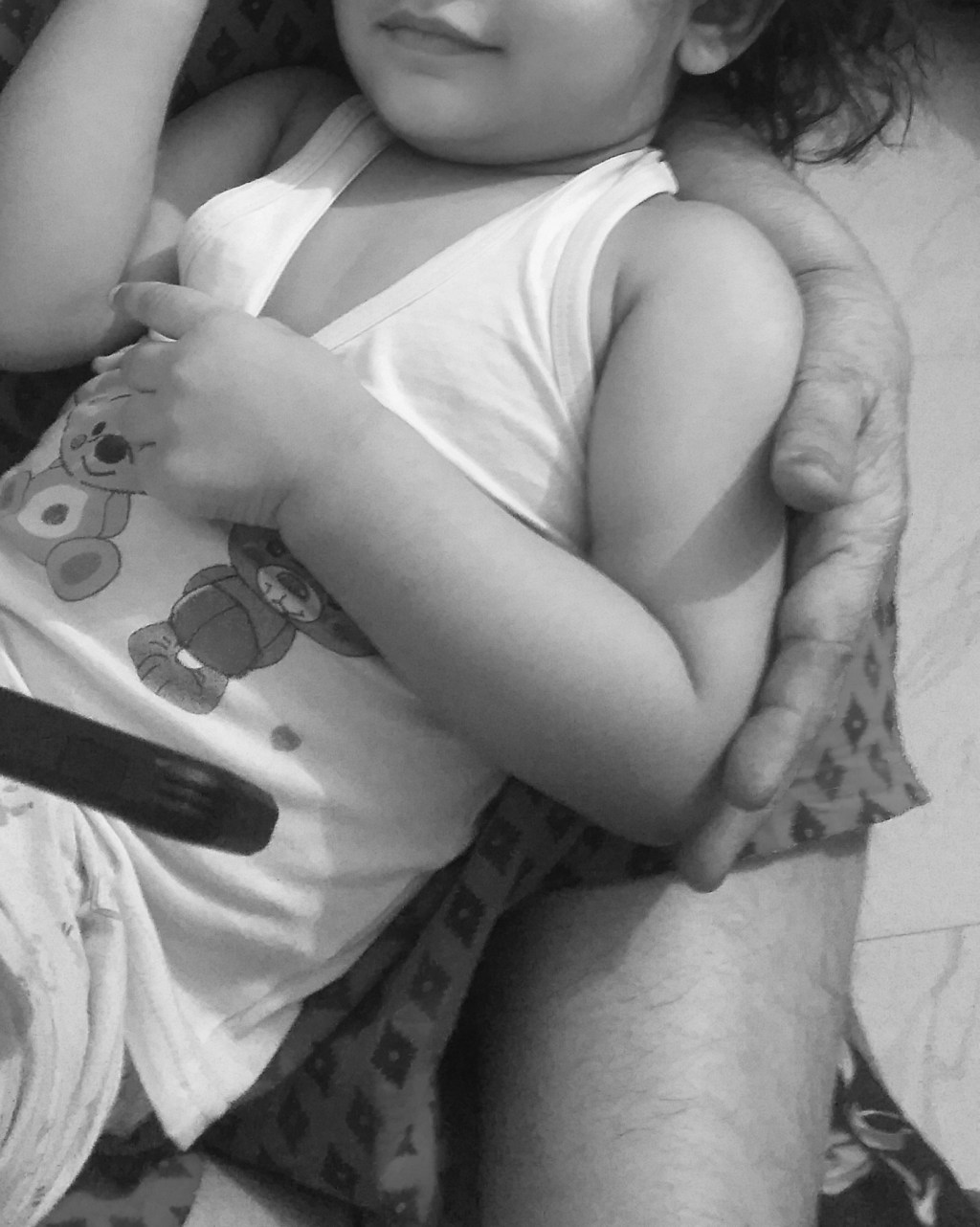
I had a dream about my son, S, a few days after he was born not breathing. I was in the bathroom and his brain was a monster and it was dying. Or it was being eaten by a monster and dying. I never told anyone about it. I was afraid they’d think that I couldn’t love my son because his brain was a monster. Or worse, that his brain was being eaten by a monster and he wouldn’t be my son anymore.
Every time I smell hand sanitizer; I’m back in the NICU with S, my body only one week empty.
It was the day of his first MRI. I remember wearing my favorite maternity pants, the jeans with the short, soft, blue, elastic waist band. I wasn’t pregnant, but my belly was still round, swollen. I wore a nursing bra and a form fitting, grey maternity top, saggy at the waist.
I couldn’t nurse my baby. He was in an incubator. But I could pump. I spent hours in the pumping room, a small room off in the corner at the end of the hall in the NICU, filled with just two hospital grade chairs, side by side, with electric pumps on tables. They made a swishing-sucking sound. I always waited until both chairs were empty. One day a nurse brought a pump into the private room she found for me, and both breasts could hang out and take turns emptying.
After I filled a small bottle, I packed up and waddled into the hallway, my body a weight for my feet, also thick and heavy. I put my son’s name and birthdate on it and placed it in the milk fridge with the other ones that came before this one, all lined up in a row, oldest date—and time—first. He had a tube up his nose that traveled down into his stomach, an NG Tube. He couldn’t suckle. But he would learn.
We would learn what a brain deprived of oxygen during birth looked like.
***
For more than five years I sat on the sidelines listening to one of my closest friends confide in me about having an affair with a married man. It hurt to watch her hurt in a relationship that could never come to full fruition. I did not think I would ever find myself in a similar situation, but I did. Feelings that began as friendly with a writerly friend, escalated into romantic feelings, even though we lived thousands of miles away from each other. Our spouses had both cheated on us, so I suppose we thought that we could do the same. Or perhaps we didn’t think at all, allowing our feelings to lead us.
We embarked on an emotional affair that carried us through the pandemic and he became my muse. I refer to him as Skye. Even after losing some of my favorite people, I still found it hard to tell him how I really felt. I wrote him poetry instead and told him that he’s my “fave.” It’s much easier than saying “I love you.” At least for me.
Skye recently went for an MRI. We joked about it and the migraines he’d been having. The anticipation of the loud, thundering roll of the magnets through the machine, the uncomfortable hug of the tunnel. He’d gotten a migraine then, surrounded by the infinite curve of metal. We said it must be stress and listed all the stressful things: like navigating kids with imperfect brains and their siblings; or relationships with spouses that are not easy, but necessary; managing our homes while being in school; and living a new normal during a pandemic…the list, it goes pretty long.
Maybe the migraines meant he had a new super-power, we said, like moving things with his mind, the headaches a side effect.
Skye knows a lot about the hard things in my life, like surviving broken heart syndrome—yeah, that’s a real thing—while navigating the end of a thirteen-year marriage amidst my partner’s new gender/sexual fluidity, failed attempts at polyamory, and ultimately, because of their eight years of on/off infidelity. Add to that the fear of a pandemic that locked my family in a home where my spouse lived in the basement and instead of co-existing, we co-parented, on a good day. Skye makes me laugh even when the world feels heavy.
The MRI showed a 1.7cm mass on his brain.
I had a dream about Skye. I was trying to get to him. Roadblocks were everywhere. I looked at the screen on my phone at a series of messages; he wrote me stories about his days, but also messages that turned into games. I had no idea how to play them, but I tried. The game was colorful. He sent me a package with a letter. I don’t know what his handwriting looks like, but in my dream, it felt important to hold on to something from him. I looked at it for a long time, rolled it over in my hand, opened it carefully, read it back to front and front to back and again. I don’t remember what he wrote. I can’t see those words. But it was tangible. I wanted to hold it in my hands forever.
Scientific study of the brain shows that dreams help to file events into our long-term memory bank, and sometimes these things get all jumbled when we are sleeping, which is why our dreams don’t make sense. Nightmares are often caused by psychological triggers, like anxiety and depression. Post-traumatic stress disorder often causes people to experience recurrent nightmares.
***
My brother J had an MRI after he drowned. He was 15. He arrived at the hospital by emergency helicopter. A first responder, a firefighter, had pulled him from under the Grand River overpass, out of the Huron River, where Kent and Island Lake meet.
I didn’t know what an MRI was then.
I was 19.
When someone you love has died, people tell you that they will come to you in your dreams. It’s called a visitation dream. We have these so that there will be a letting go, a way for them to tell you that they are okay. To forgive you for not telling them that you loved them the last time you saw them.
I needed that dream.
***
What happens to brains that are deprived of oxygen? Damage to the grey matter and basal ganglia, words foreign to me before I learned how to read my son’s MRI results. These areas of the brain affect your ability to talk, walk, eat.
When my son was younger, we tried everything we could to help his brain heal and rewire. I had read about these babies that had been deprived of oxygen at birth being put in cooling incubators, which led me to read about an experimental therapy called Hyperbaric Oxygen Therapy (HBOT). In an HBOT therapy chamber, the air pressure is increased to three times higher than normal air pressure. This allows your lungs to receive more oxygen than if you were breathing pure oxygen at a normal air pressure. Your blood carries this oxygen throughout your body which helps fight bacteria and stimulate the release of stem cells.
HBOT is supposed to help heal brains that have been deprived of oxygen. We used to watch Elmo and The Wiggles on video through a glass tube, curved like I imagined an MRI machine to be, except this one was clear, so you could see in every direction. Maybe that’s why I didn’t feel claustrophobic like I thought I would, both of us squished in together, lying on our backs, him propped up on me and me on a pillow.
My mom said, “What if we hadn’t pulled the plug on J? What if I had taken him to this therapy? Would he be ok?”
The brain will suffer damage between four and six minutes of being underwater. Cold water drowning victims can be resuscitated, but brain damage will still occur. I think J was under the water for 30 mins. This is hard for me to understand because there were supposed to be a lot of kids at that river.
My son should have been born twenty minutes earlier. He was born at 3:05 a.m., on a Tuesday morning. My waters had broken on the Saturday before. We know now that had he been born at 2:40 a.m., he would not have a disability. His disability was caused by a lack of oxygen to his brain. The umbilical cord was wrapped around his neck three times. He aspirated meconium. Meconium is the first stool of a newborn and a sign of distress if it occurs in the womb. Meconium aspiration syndrome occurs in about 5 to 10 percent of births and is a leading cause of severe illness and death in newborns. The staff was not monitoring his heartbeat; they were monitoring mine. Therefore, when they looked back at the heart monitor records, they were later able to see when he was in distress. They didn’t see it then.
I often think about how I would survive if my son had not. People tell you that what doesn’t break you makes you stronger. I think we just learn how to put one foot in front of the other. We still break. I have broken many times.
***
Skye had another MRI. His tumor “did not light up like a Christmas tree.” This means that it is probably benign. But it is also inoperable because it lives on his brain stem. To try to take it out would be life altering. In four months, he will get another MRI.
“What if it grows, your tumor?” I asked him.
“I’m fucked,” he replied. “Right now, there is space for the spinal fluid to pass from my brain to the rest of my body. If it gets pushed out, it’s game over.”
We stare hard at each other through the computer, as though we are willing ourselves to travel across the ethernet into each other’s arms.
We both need a hug.
Aside from understanding each other’s sense of humor, we also understand what it’s like to have a spouse cheat on us, to have kids whose brains work differently, and to have recovered from broken hearts. Mine clinically, his metaphorically.
Dreaming is like overnight therapy. It makes traumatic, emotional events lived in the day less painful through dreaming about them at night. REM-sleep dreaming could offer emotional resolution when you wake the next morning.
“I don’t dream,” Skye said when I told him about finding my dreams the day before. I have kept several dream diaries over the years. Sometimes they are sporadic. Sometimes they go for weeks at a time. I was looking for one dream specifically, the one about my brother J.
The next morning, he dreamed his tumor was spreading and he had to have intense radiation therapy. 100% a nightmare. 0% my fault for encouraging him to dream? Maybe. Dreams are about us. They are not about other people. They are our subconscious working through our conscious.
***
My brother J drowned on July 2nd, 1996. It was a Tuesday. One month and twenty days later, I had the visitation dream that I had been waiting for.
It began at a boarding house where it was always nighttime. I couldn’t speak. If anyone approached me, I began to cry. People were always coming and going. I tried to tell passersby about J, but each time I tried, I couldn’t breathe.
In the way that dreams shift in time and space quickly, I left and started driving down the road in my tiny red Ford Festiva. A larger red car appeared in front of me. A man, unknown but somehow familiar, was driving. He was wearing white. J was next to him in the passenger seat. They didn’t see me following behind them when they turned into a store parking lot.
I stopped my car, got out, and started waving my hands while jumping up and down. They saw me then. My car was sideways in the road, and I could see J getting into the passenger side of my car. I ran up to him and he said hi, but it didn’t sound like him, and he wasn’t looking at me. When he turned to look at me our eyes locked, “I love you and I want to apologize for so much,” I said in my mind. He heard my silent apology and responded out loud, “I love you too, and I know.”
His voice was crisp and clear.
My eyes were locked on him; I was so afraid that he would leave like he had in all the dreams before this one. He stared back at me. I wanted to hug him. His eyes glowed red, like an old film camera’s flash. I reached toward him, and he embraced me, and I squeezed tightly back. I didn’t want to let go, but I knew it was time for me to leave. He laid down in my front seat and said “bye-bye,” his voice now distant. I turned around and walked, no, ran, down the road that led to nowhere and everywhere.
When I woke up, I felt all the things that a visitation dream is supposed to make you feel. It felt real. I felt he had been traveling with Jesus. I felt he was in heaven. He was healthy. He reassured me. He conveyed an important message. We communicated telepathically. I woke with intense emotions; I still felt sadness, though less regret. I felt some closure. I felt changed. I knew I could carry that dream with me to help me continue to heal.
I hoped too, that it would stop the nightmares.
***
Skye wrote a story. I’ve read it three times already. It’s more tangible than dreams. When I first met him, he told me that he wrote science fiction. When I put his number in my phone, it had his first name and “writes sci-fi” in the section meant for “business.” I didn’t know that we would end up texting each other every day. His story is science fiction, but it’s also a love story.
He wrote about his tumor. He wrote that he lied to his family and friends about the prognosis and the type of tumor. I don’t want that to be true. But when I asked him, he didn’t answer. His story is fiction.
There’s a girl in his story, and I think she is me.
***
My mom was visiting during recent Christmas holidays. J would be 39 now. “Did you know that six months before J died, you had a dream that someone in our family would die?” she asked me while pulling another stitch through her country-themed cross stitch design. The last one I remember her doing had a buck on it.
We were sitting on the couch in the living room, both wrapped up beneath a colorful knitted blanket. I looked at her incredulously. No, I did not, I thought, speechless.
She continued. “A male. I thought it would be my dad, so I spent every lunch with him after that.”
It was possible. It could have been Grandpa. His health, and chronic use of cigarettes and beer to get through the days, an indicator. But it wasn’t. It was my brother.
***
When I dream that my son can walk, is it me accepting that he will always access the world in a wheelchair? When I hear his voice making words in my dream, is that me knowing that he has words to say but needs help to say them?
S is thirteen now and wants to be a baker. We are going to get him one of those really fancy KitchenAid mixers and connect it to a switch that he can hit and turn it on and off, maybe even adjust the speed. But first we have to get a bigger kitchen.
His brain didn’t get eaten by a monster. But it does work differently than ours.
S has cerebral palsy. Cerebral palsy affects the motor area of the brain’s outer layer, the part of the brain that directs muscle movement.
For him, this means he relies on a wheelchair to access the world around him. He also eats differently, communicates differently, and relies on others for everything.
***
I do not know how I would survive if my son had not.
My mom’s son did not survive. This year she tapped maple syrup and started a small business called Bucky Moose Maple Syrup, partially named after J. His middle name was Buck. She misses my brother every day.
The brain is in charge of everything.
I need Skye to survive. In my mind, I can see him giving me a hard time when I show him this essay. He would say, “Way to guilt trip me.” And we would laugh.
We need to keep laughing.
***
Kara Melissa (she/her), a transplant Torontonian and mama of two (teen and tween). An international teacher, turned SAHM when her son was diagnosed with cerebral palsy, she provides free writing workshops for folks in need, in addition to disability advocacy work. You can find her work in HerStry, Mom Egg Review, The Manifest Station, The Calendula Review, Tampa Review, Today’s Parent, and elsewhere. She holds an MFA in Creative Writing, Nonfiction, from Antioch University LA. She is a 2022 recipient of an AWP Intro Journals Project Award and recently completed a residency at Vermont Studio Center, January 2025. Visit karamelissa.com for more.
***
image: Janvi Bhardwaj is a self-taught artist hailing from Punjab, India. Employing her phone as a camera, she captures the inherent beauty of everyday life through her photographs. Janvi’s work is a reflection of her singular perspective on the world, as she magnifies the often overlooked emotional and mental states that are embedded within mundane moments of daily existence.
 Rejection Letters