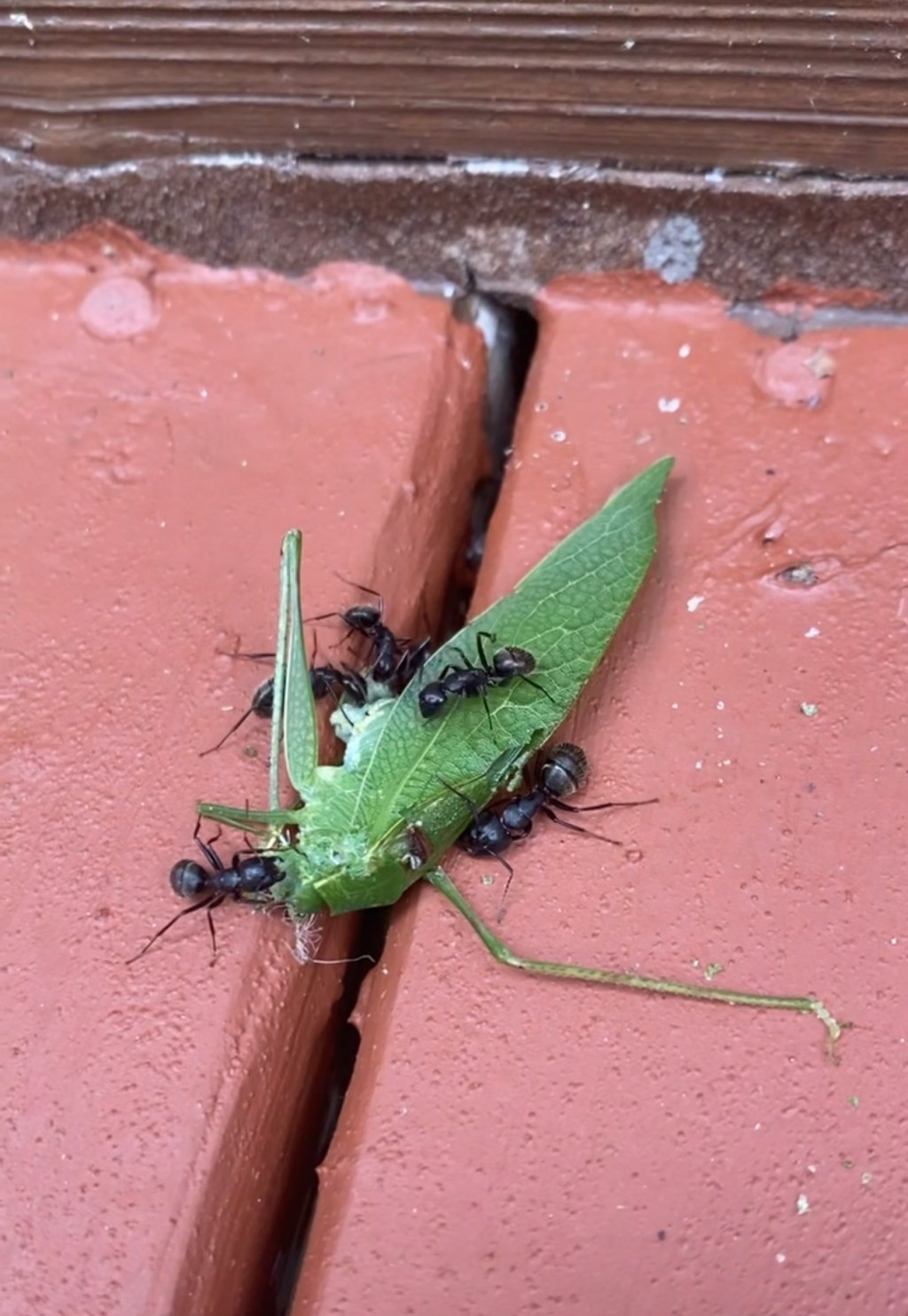
Dead things were appearing on Kent’s windowsill. The first few days it was two dead bugs, or three. He noticed them when he turned on his bedside lamp against the predawn darkness. He squinted at the tiny black things and knelt to take a closer look. The bugs lay upside-down beneath his bedroom window.
An image of death, he thought. Good morning to me.
He scooped them up with a tissue and pinched their ripe little bodies between his fingers. Pop.
All week dead bugs appeared on the windowsill: houseflies, moths, a ladybug possibly. He disposed of their tiny cadavers and got dressed for the office.
Kent considered his job menial, pointless. The main tool he used at work was a clipboard, which aggravated him. Men with clipboards, when they appeared in movies, were always nebbish dweebs who wore glasses with outdated frames, who dressed in collared short-sleeved shirts and drab ties. This was also the dress code for Kent’s workplace. Kent also wore glasses.
On Friday he hit snooze several times before getting out of bed. The dead bugs were there again, on his windowsill, but today he found more of them. Today there were ten bugs, a dozen bugs, dead, lit by the cold grainy light of a cloud-covered sunrise. Kent turned on his bedside lamp and disposed of them.
His job was grinding on him now, the absurdity of it. He set his alarm clock two hours later, and everyone looked up when he arrived at the office. He didn’t blink. Try and say something to me, you sons of bitches, Kent thought.
Now it was thirty dead bugs scattered along his windowsill when he woke up. A cricket would be lying there with the bugs. A Chinese beetle would be in the mess. He found the dead bugs warm from the midmorning sun when he woke up. Some of them had wings that looked chewed on, or crimped legs, or bent thoraxes, the longer ones. He used a dust buster to suck them up. They made satisfying thwips as they vanished into the nozzle.
Kent’s boss booked a one-on-one meeting; they needed to talk. What Kent was doing was not okay. This late-for-work business had to stop.
The next morning his alarm clock made such a disagreeable noise that he unplugged it. The bugs on his windowsill were no longer countable. Now they were piled up on each other. A praying mantis lay dead on the hill of bugs, supine and solemn, its giant alien eyes staring at nothing. The bugs on top were brittle when he woke up now, dried out by the midday sun.
Kent’s boss needed to speak with him again, urgently. This was his final warning.
Did he not realize how serious the situation was? It was coming from higher up. Action would be taken.
The pile of bugs covered his entire windowsill when he woke up the next day. A moldy funk hung in the air, and Kent discovered why: a dead bird lay atop the pile, a sparrow. The sparrow’s wing was split open at the shoulder and hung on by a gummy-looking thread. The dust buster was useless against this larger dead matter, so Kent dragged over the trash can and used his clipboard to swipe the mess away. He also threw his alarm clock in the trash, on top of the dead things.
His boss had no choice: Kent had to be let go. He needed to pull himself together, his boss said. Had he seen the grossness on his clipboard?
It was late afternoon when Kent pushed off the covers and got out of bed the following day. On his windowsill was a heap of dead bugs, with a dead rat on top, a greasy, open-mouthed creature, frozen in rigor mortis, with a hint of dumpster odor wafting off of it.
A week went by. Kent didn’t inquire about job openings, didn’t update his resume.
Now a dead squirrel appeared on the heap, with a missing paw. Now a dead raccoon lay on the pile of dead things, its left eyeball dangling out. Kent didn’t network. He didn’t dress himself. Mostly he slept. A dead opossum with a deep, coagulated wound on its side was there one morning.
Now the pile of dead things was spreading to the floor beneath the window.
Cleaning it up each day took time. The pile was wrapping around the foot of Kent’s bed when he woke up now, usually as the sun was setting. Kent left the house only to dispose of the dead matter. Soon it was multiple garbage bags he slung over his shoulder. He had to make two trips. Now three.
###
One day, or night, or morning, Kent was jarred awake by a chorus of terrible noises, a cacophony of screeches, twitters, growls, squeals, shrieks, and roars.
He opened his eyes to find his room bathed in moonlight. Every animal Kent could name was at the foot of his bed, clawing and flapping and pushing through the crowd, apparently trying to reach his window, which was shut and locked, as always.
At the rear of the crowd was a man who looked exactly like Kent himself, wearing a collared short-sleeved shirt and brown tie. He was doing dropkicks on a Bengal tiger that was gnawing on a kangaroo’s foot.
What they were doing was obvious: they were trying to escape.
When Kent turned on his bedside lamp, the noises stopped. Every insect, arachnid, crustacean, marsupial, reptile, and mammal was looking at him. He got out of bed. They backed away from the window in unison, their heads bowed in supplication.
Here, Kent said. He undid the lock and lifted open the window. See?
Then he climbed through the window, and the animals followed, and they washed across the land, a million figures in motion. They were alive. They lived.
***
Chris Reed is a writer and editor who lives in the Midwest with his wife, two kids, plus a dog and a cat. He’s currently querying his first novel, about a high school garage band making bad decisions in the 1990s. You can find him online at chrislreed.com.
***
image: Celia Rozanski–a real creature’s creature.
 Rejection Letters