She stood outside the East Broadway Mall in Chinatown, rubbing her T-zone. The weather agitated her eczema and left dry flakes across the spots the sun touched frequently: the nub of skin between her eyebrows, her cheeks, the top of her nose. She licked the tip of her index finger and kept rubbing, trying to meld the synthetic flesh tint back into her actual skin. She was waiting for her ex. She was almost sure he wouldn’t show.
They had broken up a week ago because of how much time she was spending by the book cart. In the East Village, near her workplace where she Xeroxed magazine pages for a living, a man named Sully with a cap of white hair and a missing canine on the upper left of his jaw sold books he had purchased from estate sales. After visiting a few times, the two of them established a rapport. They would often sit there on folding stools during her lunch breaks, sipping cheap pinot grigio from plastic cups.
One Tuesday afternoon when Sully went to buy another bottle and a pack of cigarettes, he asked her to look over the cart for him. She sat for a while, fanning herself, until a man in a gray suit approached her. He flipped through a stack of tomes on New Age spiritualism, then told her he had a question. Shoot, she said. If I gave you, he said, rifling through his wallet, one hundred and fifty bucks right now to feel you up, would you do it?
She laughed at him, then thought of what a story it would be to tell her friends. She thought about the mice thumping under her bed frame at night, and her landlord, who refused to do anything about it. After pocketing the cash, she let the man take her into the alleyway and push his fingers through the lining of her shirt. She imagined he was a physician examining her breasts for lumps. A family with two young sons began to walk across, one with a red balloon tied to his wrist that thumped against the inner wall of the alley. The man grew nervous. He exited the alley and walked away.
When she told her ex the story, he removed his arm from her shoulders and curled into a ball in the corner where his bed met the window. You cheated on me, he said. She watched the muscles in his back shift in the mirror: the trapezius, the rhomboid major, the rhomboid minor. He broke up with her with his face turned toward the wall.
On her way back home, she texted him: do u still want to go to that art show in Chinatown?
He didn’t respond. And after thirty minutes spent waiting in the sweltering heat, she understood that he wouldn’t be coming. She walked alone into the cool grey expanse of the building, past stores run by cranky old Chinese men, who smoked Pall Malls and wore wife beaters hitched up their waists in the summertime. Gnats haloed them in perpetuity. The stores sold retro cell phones: Blackberries, flipped open Motorolas. No one wanted to buy those cell phones. She was convinced it was a front for selling dope.
The second floor had been colonized by a legion of hipsters who had moved into the neighborhood en masse. In shopfronts populated by fucked up mannequins, their heads askew, the hipsters shelled out herbal tinctures and vintage jackets worth hundreds of dollars. She stopped in front of a dark velvet curtain blocking a doorway, where a pretty Black girl with neon orange dreads handed her a pamphlet.
If you are prone to epilepsy, seizures, or general squeamishness, you might want to sit this one out, she said. This exhibit features body modifications, like hooks in flesh, nudity, torture and BDSM. The girl pointed past the curtain, her index finger dawdling in the dark.
Inside the room was another set of velvet curtains barely blocking the warped blue light of a screen. She was the only one there. She poked her head through. On the screen, a man with lizard scales for skin laid on a slab of marble. It barely resembled a human being. The scales were filled in with tattoo ink, glistening in shades of green and blue.
Horns emerged from its forehead and along its ears. A woman, standing off to the side, placed large fish hooks in its skin. As the hooks punctured it, its small breaths pattered in and out in sexual anticipation, as if the hooks were invisible fingers shifting over its body.
It moaned in pleasure. Uuuuuuuh. Uuh. Uuuuuh, went the low throttle of its voice. The moans laced in tight like a corset. The hooks drew toward the ceiling, leaving the artist suspended by flesh, which peeled away from its body, creating a tension so thick that it smothered the room in vapor.
A voice-over interview with the lizard played on a loop. It used to be a vice president at Goldman Sachs. It had transitioned from a man to a woman to a lizard. It said it hated its human form because it was born looking like its dad. It burned its flesh. It burned off the fingerprints of rapists and abusers. It made its body malleable for the sole purpose of eradicating itself entirely. It said that its ultimate wish was to be unidentifiable after it died. And when it left this earth, it wanted to die a dragon.
Bile rose in her throat. She closed her eyes and felt hooks sink into her abdomen. She imagined the artist dead in a bog, dragon wings—mottled with age—extending behind it. An angel that fell onto the dirt, passed between different hands and used by them before bursting into its original form. Lizard Ophelia.
I can’t look at this anymore, she whispered, disgusted, taking her head out of the curtains. Then, she looked back.
Before she boarded the subway back home, she stopped by a local grocery store to buy a bag of mandarin oranges. They had been marinating out in the heat for hours. At the bottom of her tote bag, juice leaked from the rind and coated the pages of books, turning them a wet grey.
The downtown L train was dank with sweat. She plopped down next to a couple: a man wearing a Minions t-shirt and a man with a pink mohawk and red, downcast eyes. The pine scent of her deodorant was wearing off. She was hyperconscious of the fact that her armpits smelled like a jungle.
Her earbuds blasted a hit pop song. Inertia prevented her from changing it. In the corner of her eye, the man in the Minions shirt looked at her, then leaned toward his boyfriend and rubbed his nostrils. She reeked, probably. The couple laughed. They gave her a sidelong glance and Minions pinched his nostrils again.
She pulled out a wet book and pretended to read it. The giggling continued. She marinated in her own sweat. It was dripping down her stomach now, from her breasts to her clavicle. The subway air conditioning provided little relief.
A woman in tattered scrubs stepped onto the train and began to unleash a lurid monologue to a ghost, to no one in particular. The woman gesticulated in the air. Through her earbuds, she could make out disparate phrases from the woman’s rant about a no-good man who couldn’t see what a good woman was worth if it hit him on the noggin with a sledgehammer.
The couple looked at her, then Minions cupped his nose and laughed again. One stop away from her station, she ripped out her earbuds and got ready to chew them out for talking about her. Everyone was stinky, she thought. It wasn’t her fault. She couldn’t control the weather.
She positioned her torso toward them, eyes narrowing in fight. Then, she heard Minions turn to pink hair to continue their conversation.
Meep, he said to him. Meep. Meep meep.
Meep. Meep moop, meep moop, he replied.
They weren’t talking about her. They kept meeping, covering their mouths in laughter.
She got off at the same station as them. Hands clasped, they walked up steps encrusted with dirt still conversing in their manufactured language, like two aliens ensconced in their own bubble of sweetness.
She walked home under a path lit by street lamps, snagged her key in the door then walked to the patio outside and sat on a porch step. She thought of the art exhibition. The cicadas, chirping bright, reminded her of the lizard’s long, dull moan as it lay suspended.
The backyard featured a mysterious step ladder propped up against a fence. The width of the rungs grew thinner as it shot higher up. She couldn’t see the top of it. On drunken nights, her friends, emboldened by booze, tried to climb the ladder. Their long legs dangled off each step. A few of them had almost broken a bone during these attempts. They’d grab their way up to the top using their muscle memory, then realize, with a jolt, that the ladder didn’t lead anywhere. An orange street cat crawled up to the step. It meowed at her.
Meep, she said to the cat.
Meep, she said to the stars.
***
Ash Wu is a mysterious Asian woman. Find her on Twitter @ash_wuu.
***
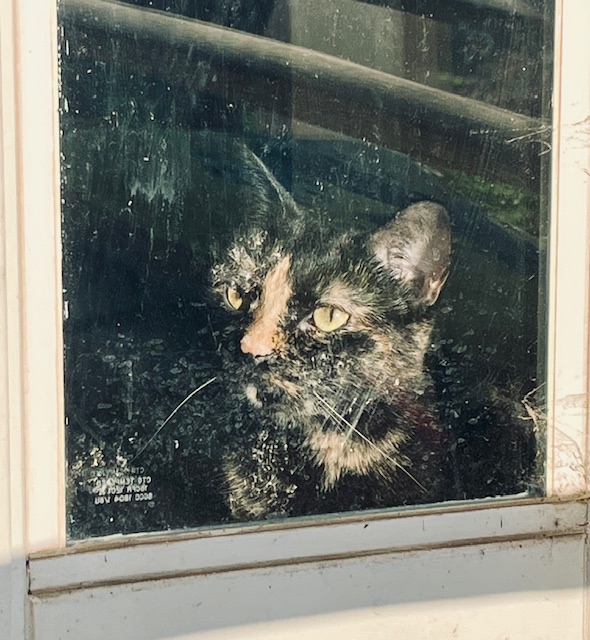
image: “Simone:” Kelly Moyer is an award-winning poet and fiber artist, who pursues her muse through the cobbled streets of New Orleans’s French Quarter. When not writing, stitching or weaving, she is likely to be found wandering the mountains of North Carolina, where she resides with her partner and two philosopher kittens, Simone and Jean-Paul. Hushpuppy, her collection of short-form poetry, was recently released by Nun Prophet Press.
 Rejection Letters