“I understand what happened. We trauma-bonded.” This is what my ex-girlfriend says to me when we meet for the first time since we left each other in a maelstrom. No contact. Just small discoveries of her silk dresses and black boots stowed away with mine for weeks after, on account of sharing identical sizes.
I am furious. She has taken our story and neutered it. I suppose it must be useful to her, but it’s dead on its feet, completely lacking color. I tell her “Maybe you trauma-bonded. I fell in love with you.” I omit that it was wild and beautiful and tragic. That we took road trips through small apocalypses. That we failed to separate our work lives from our lives. That she let me down repeatedly and when I fell apart, my brother said he suspects she’s not gay, but I don’t think it’s that simple. She is so busy being everyone else’s object of desire, she hasn’t gotten around to working out what hers is.
Since we’re learning how to be friends, she tells me about a new paramour. “You know,” she says, “it’s your typical meeting of AFAB fem-bods!” I know what she’s saying but I don’t know what she means and, to the strangers at surrounding tables, we must sound like members of a cult, or like the men who speak loudly into their earpieces in corporate acronyms while queuing for coffee, indistinguishable from well-dressed schizophrenics. I consider the assonance of fem-bod (fem-bot), and I think we needn’t have had centuries of feminism just to arrive at the conclusion that Woman is an object.
She had been romantically entangled with a man for some time. A man I introduced her to. A former friend. Time passed, and I forgive her parts of the betrayal because even betrayal has parts that move. Some months into their relationship, his charming smile revealed sharp teeth. but she didn’t leave him. Instead, she mutilated the outward signs of her femininity with an electric razor and some surgeries. Cutting off her nose to spite her face. She always was a literal person.
How intriguing, that women with all the freedom afforded them by liberal democracy and the apparently abundant choice of the free market should choose to remain yoked to men they resent. How curious that a queer woman would sooner wage war on her own femininity than the man she feels oppressed by.
I wonder about sex and gender and their frailty, how little of it we can really be in possession of, and my questions are foreclosed before I can utter them, as she concludes in a lyrical tone, “hey – gender dysphoria!” Her vocabulary has mutated during our estrangement. The words are concrete but there is such uncertainty in their delivery, a measure of irony there intended to defend her from wondering how useful they are. Because they are bloody gauze. Some language is meant to account for complexity; hers reduces it. The language of identity is only ever good to cauterize a primal wound, so that we don’t suffer sepsis while we go on living.
***
Zoe Xenakis is a writer and psychotherapist based in London. Find her at substack.com/@zoexenakis
***
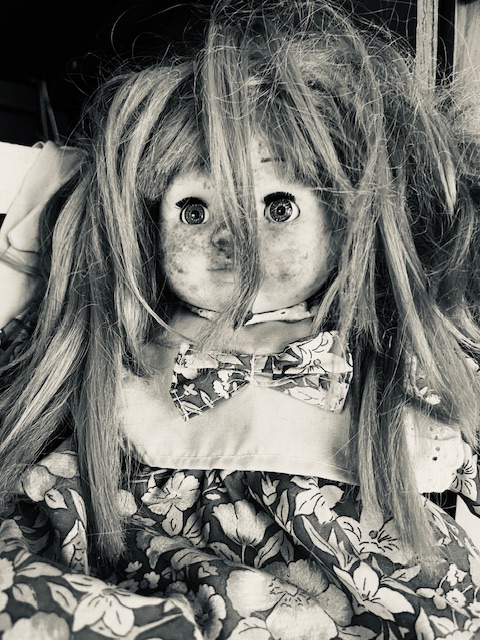
image: “Rockabye:” Kelly Moyer is an award-winning poet and fiber artist, who pursues her muse through the cobbled streets of New Orleans’s French Quarter. When not writing, stitching or weaving, she is likely to be found wandering the mountains of North Carolina, where she resides with her partner and two philosopher kittens, Simone and Jean-Paul. Hushpuppy, her collection of short-form poetry, was recently released by Nun Prophet Press.
 Rejection Letters