Once, after a long stage of semi-voluntary unemployment, I accepted a much needed job as a teacher for the Morning Light Recovery Center.
The Morning Light Recovery Center was a drug rehab center for mothers with young children. It had a messy little annex on the first floor where children of various ages could keep up with (or start for the first time ever) their education while their mothers recovered from whatever chemical substance had brought them there. The mothers would spend their days learning the skills necessary to face lives of unrelenting sobriety and their children would spend their time with me in a crowded side-room constructing/improving/perfecting an ever expanding collection of baking soda volcanoes.
The pay was garbage, but I didn’t care. I’m a good person, I thought to myself frequently. I’m doing good work.
Nobody could say that I wasn’t making a difference. That was important to me then. Not so much the actual difference-making, but the fact that my parents couldn’t say shit about what I was doing with my life. All my friends would have no choice but to be impressed with me despite all the cigarettes and alcohol and fast food I was constantly bumming off them. I had finally gamed the system. I was a saint.
Anyway, the reason I was filling all my saintly days with baking soda volcanoes was that the MLRC Educational Center had no actual “curriculum” so to speak. That was to be left to my discretion. What they did have was a massive pile of Nat Geo branded science kits, which had been donated by some church or another. So that’s what we did. We made volcano after volcano. Hundreds of them. We made so many volcanoes out there in the lawn that it ruined the grass. But we didn’t care. We were doing science. We were learning.
Then one day my boss Ryan informed me that it was not entirely appropriate for me to be doing nothing but making Nat Geo volcanoes out in the lawn day after day. He said it wasn’t really in line with the standards of education that all children in the state of Washington were owed. He said it wasn’t what we had discussed during the interview and that he would have no choice but to let me go if I continued to do nothing but make volcanoes in the lawn.
I told him I understood. I shook my head—yes of course loud and clear— but Ryan was wrong. Ryan didn’t know what he was talking about. I’m a good person, I thought. We’re learning all about geology. And so all next week we just kept on making volcanoes. We made a dozen of them right outside the office window. But by the end of the week I could tell that something had changed. It didn’t feel right anymore.
The volcano magic had vanished.
The next Monday I gathered the students in our cluttered classroom and had them write essays about what they wanted to do with their lives. Let’s see what Ryan has to say about this, I thought. I delivered an inspired speech about passion and potential and the future and whatever, and then I gave them fifteen minutes to write a paragraph on scratch paper.
Out of the ten students in my class, one said he wanted to be a bone doctor and the rest wrote about becoming famous YouTubers.
“That’s ridiculous,” I said, shaking my head. “Come on, guys. Be serious.”
Then they asked me what I wanted to do with my life, and I told them I wanted to write stories for the internet and they laughed and laughed and laughed. And I laughed, too. They got it. In their hearts, they understood.
Of course, the personal essay was just the beginning. I had it in my head that I would plan this whole big year-long project where we made maps for how to achieve our dreams by digging deep and asking hard questions and going to the library. We’d take my car out to the public library and I’d get everyone library cards. Nobody had ever cared enough to even get them a library card before me and the gesture would move them deeply. They would delve into the world of books. Their minds would become these insatiable learning machines. I would unlock a hunger for knowledge that they’d never known was in them. A whole new world! And amidst all the searching and learning and growing and striving and clawing their way out of the deep, deep pit of life’s manifold humiliations, my students would learn something about themselves as well. Something true. Something that cannot simply be learned in a classroom. Something that cannot be taught by scribbling futile little equations on a whiteboard. In my mind, this project would be the key to self-actualization. It would be an almost spiritual experience. Through this project I would be channeling Mr. Rogers levels of sagacity. We would all remember this project for the rest of our lives. But then I couldn’t find any poster board in the supply room, so I just sort of scrapped the whole idea.
Instead, I dug around in the basement and under the pile of Nat Geo Volcanoes I unearthed a heretofore undiscovered sub-pile of Nat Geo butterfly kits.
I took all the butterfly kits I could carry up to my classroom and plunked them down on my desk. I skimmed the instructions on the back of the cardboard box. The kit came with a mesh enclosure, a magnifying glass, a growth chart, a list of butterfly facts, and a little plastic tube of caterpillars. “Everything your young entomologist will need!” the box promised.
Yes, I thought, brimming with confidence. Yes. We will be a butterfly classroom now.
And so it was. We spent our days converting the classroom into a butterfly habitat.
We gathered potted plants from all around the Recovery Center and covered all the desks. We hung up sticks and bramble from the lawn on all the walls. We scattered leaves on the floor to make for a more natural and forest-like environment. But then one day I came in and found all the leaves gone and a note from Ryan on my desk which read “please refrain from incorporating yard waste in further lessons.”
Still, we carried on with the more important plan, opening every box and hanging the mesh enclosure in every corner of the room. There must have been twenty or thirty of them, and in every enclosure there were four or five caterpillars. If I were any good at math I could have told you how many butterflies that meant, but alas: I was not a math teacher. I was a butterfly/volcano teacher.
My students tried assigning names to their caterpillars but quickly gave up. There were just too many. Eventually, as a joke, they all started referring to the caterpillars as Franklin. We developed a little routine where I’d come into the classroom each morning and ask, “How are the Franklins?” And then one of my students would raise their hand and report, “Franklin 23 is good, Franklin 7 is hungry, Franklin 51 is dead…”
Weeks went by and the caterpillars morphed into gooey bananas. The Nat Geo chart said this was a “chrysalis,” but I kept referring to it as a “cocoon.” We took Polaroids of all the cocoons and hung them up around the room and labeled them Franklin 1, Franklin 2, Franklin 3, and so on. My students took bets on which one would hatch first.
We never got to find out. One Monday we found every last cocoon had hatched, and from the cocoons had emerged a bunch of flightless gooey butterflies that were all just crawling around the bottoms of the mesh enclosures. I was worried we had maybe fucked up the butterflies somehow, but one of my students read from the Nat Geo fact sheet that it actually takes a few days for butterflies to dry off from their time ensconced in goo, stretch their wings out, and actually start flying.
So our butterflies convelesced for the next few days while we fed them sugar water and cleaned the goop from their cages. Then, one by one, they started to dart around their enclosures.
Success!
Of course Ryan had anticipated that we were planning to set them loose in the classroom. We had, after all, converted into a pretty good approximation of a northeastern deciduous forest, but Ryan told me that I was, under no circumstances, permitted to do that. But he did concede with a sigh that the kids seemed engaged in the project, and so he offered to drive our class out to Riverfront Park to release the butterflies so long as all the mothers signed permission slips. “Also, Mr. Russell…” he began, but stopped short. He had this big sheaf of papers in the crook of his arm. He looked like he wanted to have one of our big meetings. But he only mumbled something about my next lessons—about how I should also teach math or spelling or anything at all like that—before disappearing back into his office.
That Friday we all packed into the Sprinter van the center usually used to transport the mothers to and from therapies and hospital visits. Ryan was dressed in a pastel pink short sleeve dress shirt and khaki shorts. It was the most casual I had ever seen him. I was touched that he had clearly tried to embrace the unregimented spirit I had worked so hard to engender. He helped us load the mesh enclosures carefully into the back of the van and very gently shut the doors.
We walked through the park, each of us carrying one or two mesh enclosures a piece, until we came upon a little meadow by the river’s edge. The sun was shining, the birds were chirping, and the dandelions swayed in the wind as the white clouds rolled overhead. It was the very picture of spring. It couldn’t have been more perfect.
“This is the spot!” I announced, and we all set down our cages down in the grass.
I felt like I should say something in commemoration of the butterfly release. Everyone was looking at me like they were expecting it. Even Ryan. It was an unexpectedly emotional moment.
“Well, we did it,” I said. “We raised these butterflies from nothing. Before you came along, these guys were nothing but little brown worms trapped inside plastic tubes. In cardboard boxes. In a weird and scary basement. Through the power of science you turned these weird worms into beautiful butterflies. These butterflies are better for you all having touched their lives, and I just think it’s important you realize that.”
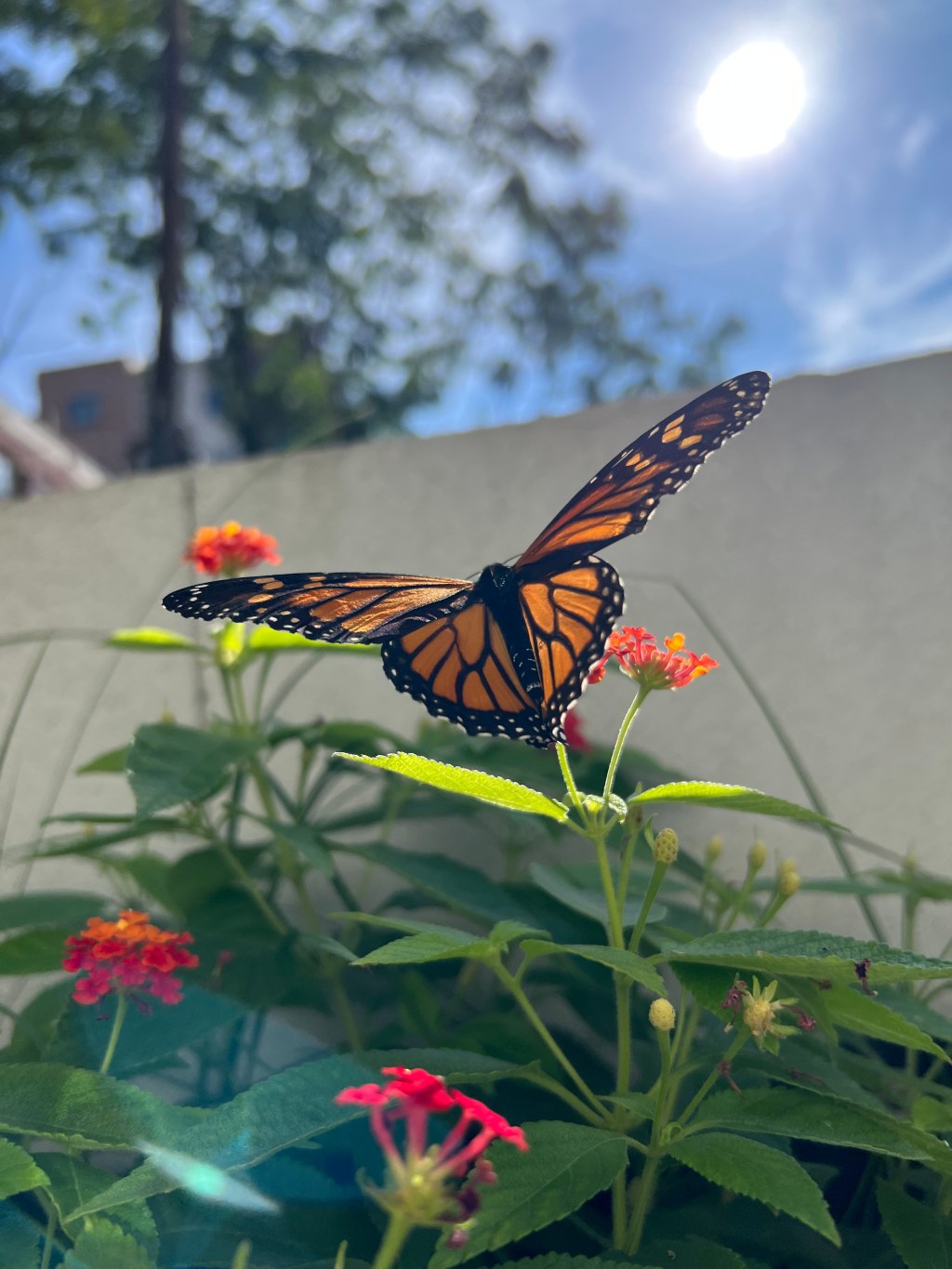
I began to count down from ten and the kids reached down to unzip the enclosure tops for the first time since we put the worms in. When I finally reached “one” there was the sound of zippers unzipping in unison, and suddenly the blue sky was speckled with warm golden wings, a kaleidoscope of light and color. We all looked up in something like awe. I think we knew something truly good had happened. And that we had made it happen.
And then a flock of sparrows descended on the butterflies and soundlessly devoured every last one of them. One by one they were plucked out of the sky and disappeared, wriggling helplessly, into a swarm of black beaks. The massacre happened in the span of five or six seconds. And then it was done. No one said anything.
I was horrified; I had given them a formative memory that would traumatize them for life. They would recite this story to counselors. They would wake up in cold sweats, dreaming of sparrows with blood on their wings. Every spring they would be gnawed at by a dread they couldn’t explain—a black pall cast all around the sunshine. They already lived in a rehab for God’s sake. Now even the butterflies had betrayed them.
But when I looked down they were laughing, wide-eyed in amazement at the turn which nature had taken.
“Franklin!” one of them shouted. “Franklin! Noooo!”
Then the others, glowing with genuine laughter, joined in.
“They killed Franklin! He was so young! He had so much to live for! Take me instead! Anyone but our beloved Franklin!”
In their hearts, they must have known this was inevitable.They had all read the folding chart. They understood the food chain. They understood how science worked. Of course they did. Of course.
Ha ha! they laughed into the springtime air.
And so I laughed, too. We all met eyes and laughed with each other. Save for Ryan, who stood at the edge of us with a tight smile set on his lips. He was looking at us funny. Like he knew something we didn’t. Or maybe we knew something he didn’t? He could have been thinking a thousand things, but the expression was short-lived. Before I could begin to unravel the tangled strings of my manager’s heart, he surprised us all by looking up at the distant silhouettes of the birds in the sky and shouting “So long Franklin! Better luck in your next life!”
Oh Well!
Too Bad!
Ha Ha Ha Ha!
***
Mitch Russell is a writer. You can read his stuff in X-R-A-Y, Olney, Maudlin House, Functionally Dead, here, and elsewhere.
***
image: Emily Bottomley
 Rejection Letters