There are a number of protective barriers not in existence, not the one to keep ours in and theirs out, nor one to surround the poky plant. None for sun or keeping the vessels off the ground. Nothing at all to block the rain.
Each of these layers of confinement and separation seemed useful, worth conceiving of, planning out, procuring materials for, unlikely to actually be gotten around to. As the steward of this segment of earth, I was once ambitious, determined to delineate. There were questions of aesthetics to be negotiated along neighboring sightlines, the possibility of shared costs, pooled labor. I had drawn diagrams. I had on hand the contact information for the appropriate authorities to evaluate and approve the projects, and to verify no harm would be done to precious underground mineral assets and infrastructure. Such aspirational records are now lost.
The threatening rhizome is long past feasible containment. It will surely now consume what remains of any surrounding plant life. The tree into which I’d invested a great deal of labor to make it bearably habitable, a lone maple that must’ve once stood a hundred feet tall before having its top half lopped clean off, is already dead, though to have it surrounded by hypodermic trichomes full of inflammatory histamine would greatly complicate coming and going. Many people struggle futilely to eradicate the stinging species from their plots, yet I planted it willingly. I was promised it was not only edible but also nutritious when properly prepared. I rightly imagined a future where we’d eventually need sustainable sustenance but did not account for the violent allergic reaction of my dependents. It hadn’t occurred to me to solicit their opinion, to allow them to taste it before facilitating its invasion. This oversight was characteristic of my inattention back when there had been anything to distract me. But I cannot dwell upon regrets. It does me no good.
The plant had been amongst the last of my purchases made with common currency, from someone who claimed a background in landscaping, before we forsook manicuring and nonessential maintenance, before we turned to bartering. For a while, the most valuable item we had to offer was our momentary surplus of multipurpose palm-sized rocks, which we were able to convince some passers-through were especially useful for primitive hammering efforts.
When Jowi hollered over from behind his barricade asking if I’d seen Boris, who’d managed to escape, I declined to relate my memory of the whimpering in the night. With my head pressed to the pillow husk, a forlorn howl had harmonized with the unrelenting wind. It was a beautiful and haunting. I’d mistaken them for sounds from a waking nightmare but now suspected they were cries of desperation from the ensnared beast.
After Jowi’s continued search took him to interrogate other neighbors I went to confirm. The plant hadn’t acted maliciously, projecting human intent onto inanimate life did not rank as credible conspiracy, but by nature of its existence severely irritates exposed flesh while simultaneously sedating any mammal that remains in prolonged contact. Boris was there, sunbaked in the middle of the bramble, just out of reach. Rather than wrap up my limbs in spare cloth to retrieve him, I decided to wait for Jowi to return or the torrent to take him, whichever came first.
The water won. From my perch I watched the shoddy raft rise with the tide, tethered to the stilts beneath me, ricocheting in the current off the clump of boulders. The more impervious, rotomolded polyethylene kayak had been dollied off by my dependents on its retractable casters, ready to be leapt into while out scouting for materials, food, our own scattered belongings. This boat was the most sophisticated piece of technology we’d had the great fortune to find. Its fins were missing, but there were pedals in the cockpit that could propel it steadily and silently. There was an intact rudder and a slot integrated into the deck just rear of the hull where a mast could be inserted, onto which a sail, if we had one, could be affixed. The shredded tarp we’d recovered and patched had blown away not long after we’d rigged it. They had only the one oar. It’d been some days since they left.
The gaps in my consciousness, I wouldn’t go so far as to call them sleep as I never came to feeling at all rested, lasted for indeterminate periods, making it hard to precisely gauge the passing of time. Sometimes I woke and the light was unchanged, other times it was clear the sun had moved, come up, or gone below the horizon for a while. I’d begun to miss them, but I’d also discovered them in shadows and glares, heard their sniffles in the wind, and found myself fingering the effects they’d left behind, both remembering them and experiencing the tangible evidence of their existence as presence. I was not worried about them, for in truth, they’d done more to protect and provide for me than I had them, their venturing out being what may have been their greatest and last attempt to do so.
There’d been so many prophecies of impending doom that it was hard to know whose version to believe had come to pass. Nothing prepared us for the random onslaughts of water, which I resisted calling floods, unwilling to invite the easy symbolism of biblical comparisons. The flow’s frequency was unpredictable, but its direction was consistent: south-southwest, seemingly towards the places that’d needed water for so long.
Debris gathered in the chute I’d rigged from salvaged lumber and downed limbs. With my jabbing stick, hewn from a sizeable branch, I shepherded the floating carcass into my pen for collection once the surface mud dried enough to provide traction. A gushing surge threatened to jostle it out of my control. How far into the distance it might have been carried I do not know, but with a deft maneuver of my wrist, I was able to right its course, nestling it safely into my splintered but welcoming bumpers. It bobbed there a while, and the stream did not abate. I grew worried that it’d find its way through a crevice in my contraption, or else be forced over the top by a vigorous wake. I tried to contrive a way to retrieve Boris’ sodden, matted remains. While it was immediately beneath me, the distance was too great to easily reach. Rope was scarce and I possessed nothing resembling a net. I couldn’t even attempt a comically large chopstick squeeze since the singular long stick was the only one of such great length I’d come across. For me to descend nearer to ground level I’d have to leave the safety of the nest I’d commandeered from absent birds of prey on the strongest branch of a long-dead tree, maintain my balance a distance of ten paces back towards the trunk, and then carefully scale down thirty feet from there to the lower foothold, where water was nearly lapping. From there, I’d stand a chance of dragging Boris upstream back to me with my stick, if I could figure out how to get the stick down there with me. Any other harvestable limbs had already been felled and put to some purpose, and I did not have the proper tools to sever any others that might have been useful. I somewhat preferred them where they were, lending some degree of symmetry and privacy to the structure. I kept a firm grip and carefully eased the stick down towards the foothold, wedging it against the trunk, and nestled the top end in the nook between two stout branches. Barring a great impact, I felt reasonably assured it would stay put.
For whatever reason, I felt I owed this to Jowi, with whom I’d rarely passed anything but pleasantries. I’d caught Boris on the run once before right after Tomas had left, gathered him up in my arms, allowing myself to be thrashed against and bit as I brought him back to the confines of their unattended enclosure. I hadn’t had occasion to explain the event to Jowi, hadn’t wanted to call attention to myself or to make him feel in any way indebted. We had what I thought would be grounds for solidarity in our sharing of a landlord, a well-fed man outfitted in the most cutting edge of textile technologies, who spoke few words and emoted little when he appeared sporadically, often following a receding gush, and only exhibited much animation as he would gleefully collect arbitrary amounts of our food and other supplies. For some reason, in spite of our righteous griping, we let him. Unfortunately, this commiseration failed to blossom into any greater bond. The rest of our interactions were perfunctory, logistical. Could I keep an eye on the horizon for half an hour while he’d do something vague and unexplained that must’ve made him feel vulnerable, would he be willing to hold up the other end of this crossbeam while I propped it up and bound my end to the trunk? Might he borrow my rake for the afternoon to retrieve his wind-strewn bedding nettles, could we let one another know if we discovered a source of untainted groundwater or a good vantage point for surveying migratory patterns?
Most of Jowi’s requests pertained to his and Tomas’ restrictive diet, which I admired them for. Under the circumstances, red meat and fresh vegetables were no longer readily available to inexperienced hunters and farmers, so they exerted a great deal of energy planning and preparing to avoid foods dangerous to their microbiome. Failing to do so might’ve brought about a sooner and more grim demise than starvation. Jowi couldn’t be entrusted to venture far, as due to some obscure condition he was occasionally taken with violent seizures, returning to consciousness completely disoriented and often inexplicably far from where he had been. I reasoned that was why Tomas had been the one to depart, as part of these schemes of nutritional necessity, some days before my own filial scouts had. Perhaps they’d all banded together out there. I was unaware of any preexisting relationship between them, but the thought gave me comfort.
Arms outstretched, carefully planting the balls of my feet on the apex of the branch, avoiding knots I knew to be destabilizing, I headed back to the trunk. The tree was bald wood, completely stripped of bark. Its smoothness was a balm to my anxiety about splinters and had allowed me to fairly easily notch out small footholds every couple of feet. I’d had friends who climbed rocks recreationally when that was still a thing, but I’d never gone with them, always declined with some dishonest excuse, and so had very little understanding of grip techniques, knots, and confidence in mere fingers to suspend body weight. Thankfully, scaling up and down from my perch was the extent of my vertical travels, and it’d become second nature. It occurred to me to have concern for Jowi, who may not have been prepared for the inundation, though to have lasted this long, he had to have his ways of reacting. I paused in my descent to scan the horizon and saw a still mass atop the slowing water, floating with the assistance of something broad and buoyant, but I could not make out the precise shape of what must have been at least one animate body. There was a new salty smell that hadn’t reached so far inland before, though, with the concept of shoreline undergoing such a broad redefinition, I clearly couldn’t any longer consider myself landlocked.
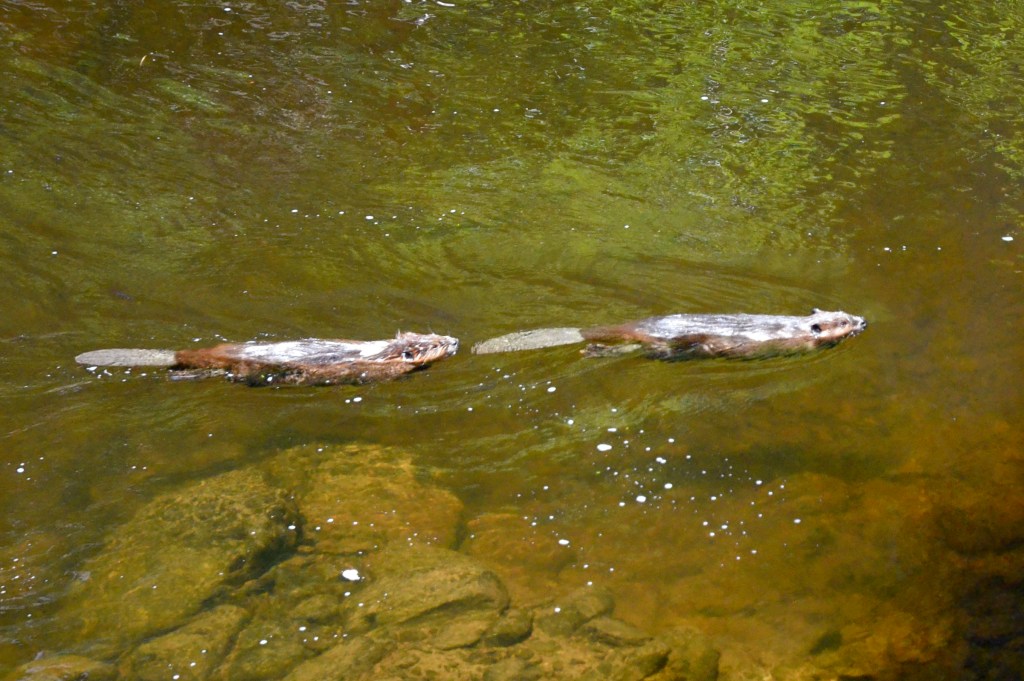
From beneath me came an ungodly vocalization, a guttural tearing of my eardrums. Walrus-like tusks gnashed at the tree trunk, gouging the wood. A flipper splashed an impressive amount of water up over my feet. I scrambled back up to deny the creature the satisfying taste of my flesh. It gave up pursuit and gracefully plunged beneath the surface, creating a gentle, radiant ripple, followed by a small bubbling expulsion of air, and a peek at its gleaming cinnamon backside curving briefly up into the air and then back below. While environmental changes had bound some lives like my own more closely to where we found ourselves, many species took the opportunity to traverse previously inaccessible terrain, which is why I’d become quite familiar with the taste of turtles, frogs, birds, and beavers, though I had yet to see aquatic life pass through my yard that wouldn’t have been at home in a lake. Whether by choice or necessity, this marine mammal must have traveled thousands of miles to me, to my pen, where it had found and was now consuming the lifeless body of my neighbor’s likely last companion. I couldn’t quite imagine in the moment how to explain this all to Jowi, but my instincts told me I ought to at least attempt to prevent Boris from being completely digested, if for no other reason than to be able to say with a straight face that I had tried.
Back in my perch, I retrieved my stick from the nook, took a wide grip, and swung it over to strike it squarely in the snout. I hadn’t made direct contact with the sharpened point, but the impact caused the monster to resume its roaring, fending off my unwieldy weapon with a flick of its tusks. Resorting to armed violence, taking joy in wounding an animal did not suit me. I’d come to terms with the necessity of what hunting I’d done, but this felt more like an unfair fight between beings otherwise much closer to equals. In my moment of hesitation, the walrus thrashed from side to side as if to evade further attack, and then darted off to the side outside my reach, straight into the floating tentacles of my stinging patch. I winced and braced myself against my compounding guilt, uncertain if the leaves would have any effect while submerged, unsure whether they’d work on such a creature, hoping that they wouldn’t, that it would escape unharmed, able to find another meal, albeit far away from anyone related to or known by me. Neither it nor I were so lucky. It lurched and writhed as if tased with electrical current, making increasingly pathetic attempts to free itself from the herbaceous teeth. I knew the plant’s pain, had lived with its rashes for weeks after a careless stumble in the wrong direction, but this reaction far exceeded my fears. I was overcome with shame, and in order to relieve it, thrust my stick like a javelin, successfully plunging its tip into the creature’s head. As it began to sink, the part of my mind unburdened by sentimentality flitted from plans to gather my stick to possible uses for blubber and tusks, to which my emotional side responded by feeling apprehension at being condemned as a poacher, accused of deliberately killing the animal for that specific purpose, which concern was quickly tamped down by reasoning again, wishful though it may have been, that such sensitivities must certainly be extinct by now, that anyone still alive would see things from my perspective and have no reason to doubt my account, would agree that I had no other choice. I mentally constructed my explanation for Jowi, bolstered by the fact of the two corpses I had to show as substantiating evidence, though wondered if it would be enough of a diversion to escape scolding for my neglect in failing to contain my killer plant, and then remembered the approaching figure or figures I’d seen afloat. I spun around to locate it or them and saw a similar sight, slightly enlarged by proximity, but still too distant to discern any more detail other than that there were definitely at least two bodies. I wondered if they’d been able to see, all, just part, or none of what had happened. If it was my people, I couldn’t decide if they’d be proud or terrified, if they’d fear I’d lost myself and deal with them similarly. In the event that it was Jowi, I wondered who was with him, if he’d found Tomas, was he alive or dead, and if not him, if it was one of mine. If the body with Jowi was not yet known to me, they might be coming to harm me or might decide to do so when they discover what I’d allowed to happen, what I’d done. I imagined they’d enjoy my perch, perhaps make even better use of my resources than I had. This may have been something they’d been plotting for longer than I’d been aware.
I admit I’d had fantasies myself, not of causing anyone harm, but of their not being here anymore. None of them had ever been much of an inconvenience. I’d like to believe I might’ve befriended them under different circumstances. I was hungry and perhaps delirious. Regardless of who it was, at least they were coming for me.
***
Crow Jonah Norlander lives in Maine with his family of humans and hounds. His short stories have been published in Fence, Juked, Peach Magazine, and elsewhere.
***
image: Angela Townsend is the Development Director at Tabby’s Place: a Cat Sanctuary. She graduated from Princeton Seminary and Vassar College. Her work appears or is forthcoming in Arts & Letters, Chautauqua, Paris Lit Up, The Penn Review, The Razor, Still Point Arts Quarterly, Terrain.org, and The Westchester Review, among others. She is a 2023 Best Spiritual Literature nominee. Angie has lived with Type 1 diabetes for 33 years, laughs with her poet mother every morning, and loves life affectionately.
 Rejection Letters