The week I left my husband was one of those weeks that feels like a million years. I’d had an abortion only a few days prior to getting on a plane for New Mexico. I hadn’t told anyone about it. That’s the normal protocol for secret abortions resulting from extramarital affairs. The way I see it, if you are cheating on your husband and you get knocked up and you don’t know for certain who the father is, you only have three options to choose from. One, you confess—pray for forgiveness and spend a lifetime atoning to your partner with no guarantee that they won’t eventually come to their senses and leave your ass. Two, you end the affair in secret, play pretend, raise the baby with your husband never letting on that you stay up at night wondering who the father is and fear one day you will be found for the fraud you are. Your whole life a lie, and by proxy, your spouse’s life too. Three, terminate the pregnancy, terminate the marriage, and get the hell out of dodge.
I went with option three. I took a Lyft to and from the clinic while David was at work. Spent a day in bed playing sick and planning my escape. On the day I left, my husband didn’t even say goodbye on his way to work. Of course, David had no idea his whole life was about to change, that when he’d get home, he’d find a note on the counter from me that read, I don’t love you anymore. I’m sorry. I hope you find happiness with someone else. Please don’t try to find me.
It wasn’t an easy thing to do, but it was easier than the alternatives. I cried the whole drive to the airport. Part of me was mourning my marriage, but the other part was mourning that I hadn’t become the type of woman I hoped California and college would turn me into. A woman who read books and went to art museums and had a man that reached out to hold her hand in a room full of people.
Not long after David and I were married, we took a trip up north with his mother to stay in a cottage and feel close to nature. It was something his family did, taking weekend trips to rural places where the locals lived in trailer parks tucked behind giant conifers, away from the gaze of tourists. Before we made it to the cottage side of town, David pulled off the side of the road to get gas at a dilapidated white station. There wasn’t a single car in the lot that had a matching set of tires. In the fuel port next to us, a white woman with a large belly and peroxide blonde hair smoked a cigarette and yelled at her son to share his Hot Cheetos with his baby sister. Near the trash cans, an emaciated man with no shirt and pants sagging low enough that you could see his pubic hair drank from a tall can of Steel Reserve. His skin was sun-leathered and he swayed back and forth like his mass was too small to hold itself up against the elements.
David’s mother, a woman, who, like David, was a vegan and worked as a professor at Berkeley, went into the store to pay for the gas. After we’d filled up, the three of us safely inside our Prius, David’s mother looked out the window and shook her head watching the gas station disappear behind us.
“How depressing,” she said, “Everyone here looks like they walked straight off the pages of The Grapes of Wrath.”
David nodded his head in agreement. I sat in the back, watching their heads nod in tandem, wondering what they would say if they ever saw where I’d grown up. They’d met me as a bookish college student far from home. I worked hard to uphold that image.
#
The story of how I ended up here, awaiting whatever fate a jury will give me, wouldn’t make much sense if I didn’t at least include something about my mother, though I imagine this part of the story might be considered extraneous in court. Hell, every detail besides who fired the gun might be considered extraneous. Funny how a life in the eyes of others can be distilled down to such a limited number of details.
“In a sensitive case like this, it’s imperative we’re strategic about which details we include,” my lawyer says. I keep thinking about Aileen Wuornos—how at first the details made her sympathetic, but then, in the end, when the jury had heard too much, she became something else. I first learned about who she was when I was in middle school. My mother took me to see a biographical film about her in the theaters. Monster, it was called. We never finished watching it, though. Less than halfway through the movie, my mother grabbed my hand and pulled me up from my seat to leave. The scene on the big screen as we were walking out was a battered and restrained Charlize Theron, playing Wuornos, laid out across the front seat of a car. Half-conscious from the beating, the man sodomizes her with a pipe as he tells her to scream. Through the dark hallway leading out of the theater I could hear Theron screaming in surround sound. In reviews I read later, not one described the rape scene in detail. Like most assaults to women, they said things like “vicious” and “heinous” but how different those words sound than Theron’s character, bloodied, beaten, restrained and half-conscious was raped in the ass with a large metal rod as her attacker kicked and screamed at her to make some noise. Even in Wuornos’ testimony, as she tries to describe her rape, she struggles to find the language for what was done to her. At one point she refers to rape as sex. Through tears and staggered breaths, she interchanges words like anus and rectum area, constantly pausing, to mumble I don’t know what to call it, or simply I don’t know. In the description of her sodomization (no pipe mentioned in the testimony, so maybe that was Hollywood), she says “I don’t know if he came—or what—or climaxed—I talk street talk, so I don’t know if he did that.” She shrugs, looks down, looks to the lawyer as if seeking validation that she is using the right words to describe the action correctly. Plenty of reviewers described Monster as a sympathetic take on the story of Wuornos. Lot of good that did her. Probably not in my best interest to draw any parallel lines between me and Wuornos. I was never a prostitute. I never went on a killing spree. Like Wuornos (and the media), I too struggle to name what happened to me, but I would never describe rape as sex. I might agree that Wuornos is a criminal, but I would never call her a monster. Maybe my own fear of what might happen to me is making me more sympathetic, tempted to believe that context matters, that people don’t do things for no reason. What caused an action should mean something. Maybe it should even mean as much as the (re)action itself.
As far as I see it, details matter. The story of what I did wouldn’t exist without the detail of returning to my mother. She still lived in Las Cruces, New Mexico in the house we’d moved into when I was eleven. It had started out as a rental, but eventually the aging landlord sold it to her. She’d never intended to buy it. It had been meant to be a temporary landing spot after she left James Dixon, my stepfather. In another life—the one before I got arrested, and really, the one before I made my way back to New Mexico—I never mentioned him. I didn’t even think about him. At least, I worked hard to never think about him. With everything that happened, I guess there won’t be any avoiding bringing him up. But, for now, I want to talk about my mother. About what a mistake it was to return to that house of hers where she was never meant to stay.
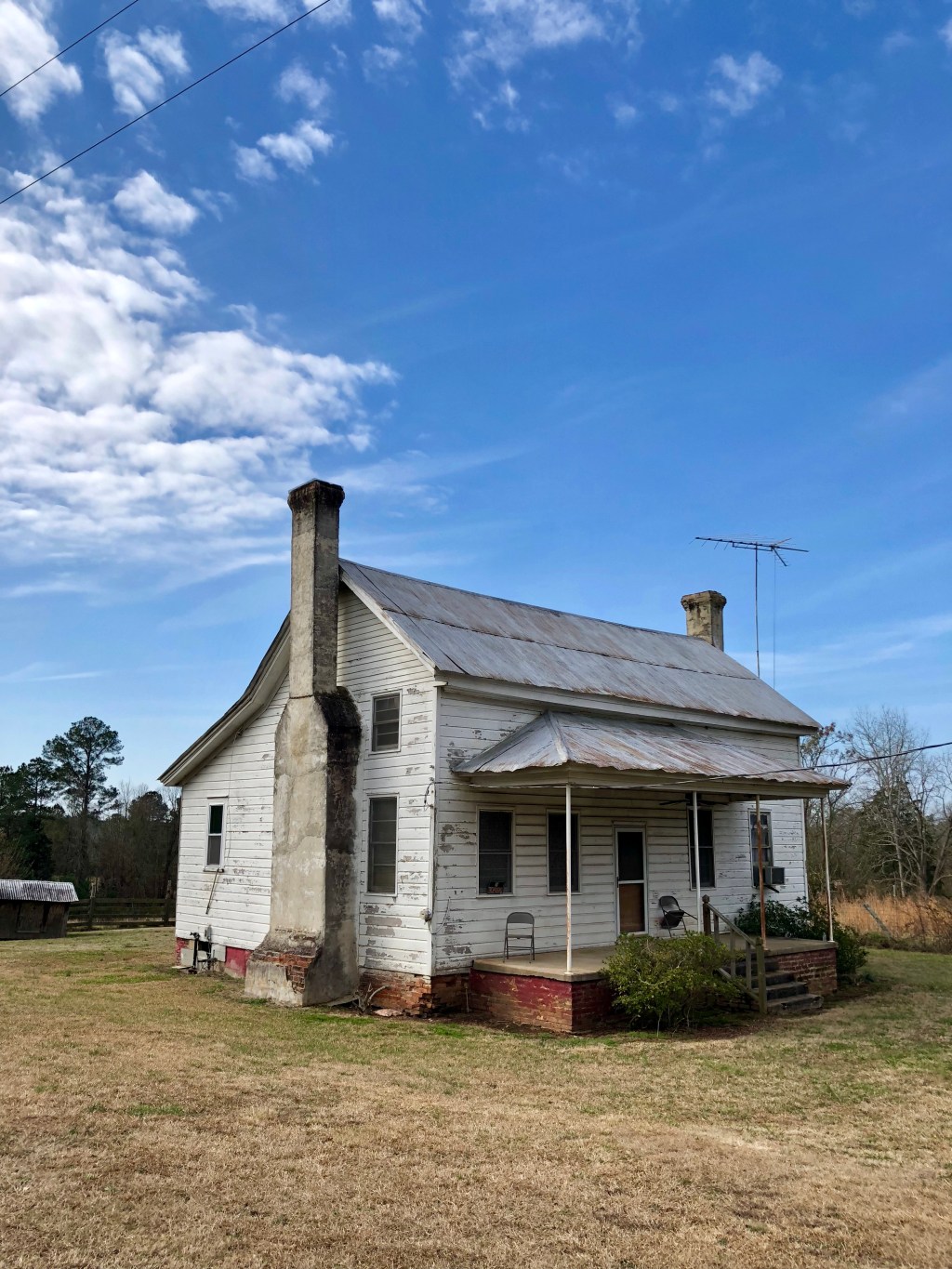
I hadn’t been back in over a decade, and I didn’t know why it was the first place I’d chosen to go after leaving my husband. Maybe a simple lack of options. The front lawn was full of knee-high weeds that looked like a drying golden forest in front of the single-story adobe style home. Teal trim lined the doors and windows. On the garage she had painted what looked like a roadrunner-jack-rabbit creature in various shades of greenish brown. When I’d lived in the house, it had been off-white, old, and unmemorable like all the others in the neighborhood, but it appeared my mother had gotten creative since I left.
“Where’s David?” she asked from the front door as I rolled my two suitcases over the crumbling walkway.
I shook my head.
“Oh,” she nodded, “You know, I always thought it best to leave everything behind.”
“Maybe I should have.”
She didn’t lean in to hug me as I approached. She stepped aside to let me pass and I could smell the burn of vodka that permanently laminated her skin. Instinctively, I looked at my watch. 11:45 in the morning. Old habits die hard, but none as hard as tracking the start time of your mother’s drinking to map your movements for the day. It wasn’t a fair judgment. After all, I’d had a Bloody Mary on the plane myself. Then another. And another, until I could see the discomfort palpable on the flight attendant’s face like she was about to have to cut me off but didn’t want to.
“You won’t believe what I have done with your old room.”
I followed her down the hallway and the smells of adolescence came to me like the pillow that smothers you to death. Cigarettes and liquor. Patchouli and rose soap. Dog piss and bleach.
“I ripped up the carpet and painted a constellation on the cement.”
I looked at the cracked floor of my old room. It was painted black and smudged in the places where she had stepped before it was dried. There were yellow and white polka dots splattered in no ostensible order.
“Exposed foundation is really big in Europe right now.”
“Looks great.”
“Let’s have a drink, huh?” She said, and I thought about fighting the urge to say yes simply to refuse her indulgence, but I didn’t know how to be with her without a drink. I needed something to ease into this new life, this sudden change of being thrust hundreds of miles through the air out of one life and into the next. Everything had moved so quickly. A drink could slow down time. Give me a second not to feel like everything was moving too fast to grasp.
“Sure,” I said and followed her into the kitchen, relieved in some way that she was still the same woman I’d always known. The kind that could solve any problem with a drink.
The call from David came the next night. The house phone rang right as my mother was sliding two frozen pizzas into the oven for dinner. I don’t even know how he found it.
“Will you get that for me, Bean?”
“It’s him.” It came to me like a vision, her house phone ringing in the dim-lit kitchen and my husband on the other line, calling the wife who’d left him and blocked his number. I could see him sitting on our couch in our tidy living room, body leaned forward as if he could transport himself to where I was. I felt an urge to reach into the phone and touch him, tell him I changed my mind, I’d made a mistake, I wanted to go back to pretending I could be a wife. I could make up a semi-believable story and things could return to normal—my looming thirtieth birthday and fear of not being good enough for him the cause for my erratic disappearance. Play it off as insecurity and self-doubt. It might hurt him, but he could forgive an existential crisis if I could be doting. Eventually I might even settle into a calm, not altogether meaningless life shelving books in a library and being home in time to cook him dinner every night. He could continue on the path towards becoming a tenured professor and his world would be big enough for the both of us, big enough to consume what I’d been trying to escape the first time I’d left home.
My mother slammed the oven door shut with her hip and walked around the counter to where the phone hung on the wall. “How do you know?”
“I just do.”
“California turned you clair-ee-voy-ant-ee” (and that’s how she said it, pronunciation all wrong the way so many words got twisted up on her tongue and came out incorrect). She wiped her hands on the front of her jeans and picked up the phone. “Vicki Barnett speaking,” she said, the mock professionalism undone by a slight slur.
“Oh hi, David, and to what do I owe the pleasure of a call from my favorite son-in-law?” She winked at me like she was about to enjoy this game of telephone with the husband of mine I’d never introduced her to. I put my head in my hands and willed the conversation to end quickly. He must have been talking in his fast, ranting manner because my mother wasn’t saying anything. I wanted to take the phone from her so I could hear what he was saying, if he still loved me or if I had already become a monster in his eyes. It wasn’t right, that I should desire his love despite my inability to love him back. Whatever love he felt for me wasn’t really for me. It was for the version of myself I showed to him. I loved her, too—the woman I wanted to be—but the real me, the one that’s capable of pointing a gun at a man and pulling the trigger, wouldn’t let her live if it meant having to be erased. I know this now. David does, too. But he didn’t then. Not yet, and so he thought he still loved me, that the woman he’d met still existed.
“No, I haven’t heard from her. You know Sabine, she never does tell me anything.” She paused, listening, and her face fell into a frown. “Well, David, I will give her a call, but I don’t know how much she’ll listen to me. Once that girl gets something in her mind, she sticks to it.” She paused again and nodded her head as she listened, “Ok, you take care of yourself. I am sure it will all work out the way it’s supposed to.”
She hung up the phone and walked back around to the other side of the counter. She reached into the cabinet and pulled down an expensive looking bottle of gin and two tall glasses.
“What on earth did you do to that man, Sabine?”
“I don’t want to talk about it.” Her eyes scanned my face, and I shook my head. “Please?”
“Okay.” She bit her lip like she was keeping herself from talking, and, for a second, I thought I saw a wave of disappointment wash over her eyes. Maybe she’d hoped that failing at marriage would unite us in some way, that we could share battle wounds and somehow finally connect with one another, be a real-life version of the Gilmore Girls, but our problems had always been a lot less white collar than those CW approved family dramas, and we’d never been the type of mother and daughter that had long drawn-out conversations about our feelings. In the 12 years since I’d been away, I could count on one hand the times we’d seen each other in person.
“Why don’t we have a drink?” she said. We’d already been drinking—cheap Irish cream and coffee for breakfast, her signature Diet Sprite with vodka as we watched daytime television in her dark living room—but she asked it like the idea was something novel.
She pulled an ice tray from the freezer and plopped five big cubes in each of our glasses before pouring the gin in just below the rim. For a second, I wondered what it would be like to tell her everything. How I’d been unfaithful to my husband. Not just with Avery, but with other men too, in lots of little ways. Mostly flirting, some texting, never anything as far as I’d let it go with Avery, but there was something inside of me that needed too much. Why wasn’t the love of one man enough? Why wasn’t any of it enough?
“Cut us one of those limes, Bean.”
I cut one of the limes into wide wedges that she squeezed into our glasses and stirred with her long, skinny finger. She licked it clean and passed me a glass.
“To forgetting exes,” she said, raising her glass in a toast.
“Cheers.” We clinked our glasses, and I took a long swig. “Nice gin.” I turned the bottle towards me so I could see the label. It was a big cylindrical bottle with frosted glass and cursive font across the front. I wasn’t used to seeing my mom with such expensive looking liquor. Her taste had always been whatever gets the job done cheapest.
“I stole it.”
“I don’t want to know.”
“Some asshole from the Fork in the Road who’d been hollering at me for weeks. I finally said I’d go out with him, you know how it gets when you’re feeling lonely, and he drank so much of the damn stuff that he couldn’t get it up.” She threw her head back and laughed.
“Seriously, mom? I really don’t need to hear this.”
“He was an asshole. I’m telling you.” She clucked her tongue and her head swayed on her neck like a leaf in a heavy breeze. “He badgered me forever and then, when I’m finally feeling like I need a man and any old one will do, he can’t even show up at the shop. Didn’t even get out of bed to walk me to the door. What do I care if he thinks I’m a thief?”
“God, you are fucking crazy. You know that?”
“You know, he had one of them globe on wheels things that looks like the world, but when you open it up there’s all sorts of bottles inside. Have you ever seen one of those?”
“I think so.”
“Fancy Californians you know probably got plenty of shit out there like that. I snatched the fullest bottle he had right up from the world. Nice shit, too, though I’m not usually a gin drinker.”
“Well at least you got something out of it.”
“Sometimes, being a bitch is all a woman has to hold onto,” she said, lifting her glass to mine, a toast to bitches everywhere. It was a line she’d been using since I was a kid. It was a quote from the film Dolores Claiborne, and she used it any time she needed to justify her erratic behavior. What was worse was that the film was an adaptation of the book which I’d never seen her read. I’d never seen her read any books for that matter, which is probably part of how I got it in my head that I could go to college and read books and somehow I wouldn’t wind up like her. It was a judgmental thought. Naïve to think that I could be better than my mother if I just lived a more intellectual life than her. As if that was all it took. As if there is such a thing as being better than someone else. Isn’t it all a matter of opinion? And really, for all the books I’d gone and read, I was still standing in my mother’s kitchen, drinking her stolen gin, and cringing at her quoting a film adaptation of a book she’d never read.
When the pizzas were done, she mixed us two more drinks and I picked a movie. We ate and drank and didn’t share another memorable word for the whole night. Every so often she would take our half-empty glasses back into the kitchen and return to the couch beside me with full ones. If nothing else, my mother was great at helping to anesthetize my mind.
I don’t exactly remember going to bed. It wasn’t so uncommon—blacking-out before bed and then waking in a fit in the middle of the night. For some time, I had wondered if David had noticed my restless sleeping, how sometimes I’d wake in a sweaty panic in the middle of the night and the only way I could get back to sleep was by getting out of bed, walking to the kitchen, and taking a long pull from the whiskey bottle I kept tucked in the back of the oven drawer.
After the phone call from David to my mother’s house, I drank glass after glass of her stolen gin. No amount of frozen pizza could soak up the level of drunk I was on my way to. We sat in the living room drinking and watching reruns of Law & Order and then whatever came on after it. I had no memory of standing from the couch and walking myself to bed, but I woke up there, in just my underwear, a pile of drool gluing my face to my pillow, and a hangover as bad as they come. The usual morning-after montage began, thrusting disjointed images into my conscious brain until I had enough information about the day before to know the headlines of my life but not enough to understand what it all meant and how it all fit together. I recalled sitting across from my mother, her sing-songy voice on the phone with my husband and I felt the wheel of gin and shame turning in my gut. There was no way David didn’t know that I was at my mom’s house. I just knew it and it was enough to serve as an excuse for me to get the fuck out of there before he showed up banging on her door. Not that I saw him as the type to bang on doors, but she didn’t know that, and it would be easier to blame my leaving —which I decided right there in my drooly mess was the next right move—on him.
It wasn’t just David’s phone call that told me I should get out of there. It was the whole sad mess of her house, the way even with all the lights on the place was perpetually dim, the way the swamp cooler didn’t make the house cold it just turned it into damp heat, the way even through a black-out sleep I woke in a panic I hadn’t felt since childhood. I knew I had to leave. The dreams at my mother’s house were more visceral than they were anywhere else and even my honed skill of blocking subconscious thoughts out over the years wasn’t a match for the way they took hold of me there, woke me with my muscles fighting to break free from the prison of my flesh. With my eyes closed in bed, all I could see was the face from my childhood, the one I’d spent most my life trying to forget. In the night, in my dreams, it was breathing its lactic, tobacco breath on me. Its body on me, so much bigger than me. I was tangled in the sheets, fighting it away, but it was too strong, and I woke with my heart pounding, throat a closed fist, gasping for air. I needed to find a place where less history clung to the walls.
***
Shelby Hinte is the Associate Editor of Write or Die Magazine and teaches creative writing classes at The Writing Salon in San Francisco and online at Writer’s Workshops. She has served as a reader and intern at various independent presses including ZYZZYVA, Split/Lip Press, and No Contact. Her work has been featured in BOMB, ZYZZYVA, SmokeLong Quarterly, The Rumpus, and elsewhere. Her first novel, HOWLING WOMEN, is forthcoming from LEFTOVER Books (2025). She lives in Northern California.
***
image: Ashley Beresch. Check out more of her work on Instagram @ashleyberesch
 Rejection Letters